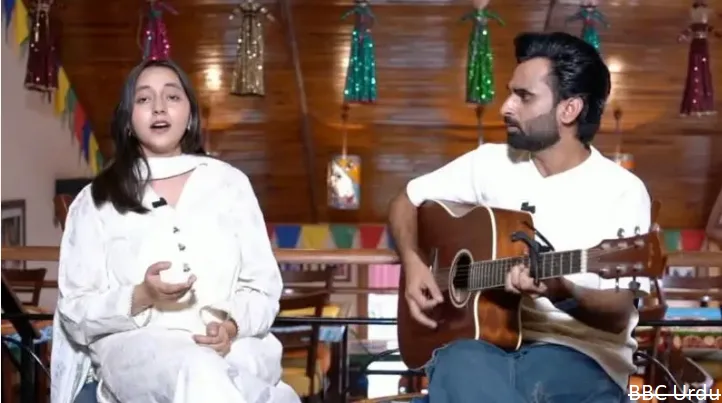
From Job Hunting to Viral Fame: How Shanze Sial’s Saraiki Song ‘Chhalray Chhalray Waal’ Won Hearts Across India and Pakistan
LAHORE, Pakistan | October 21, 2026 | Digitalita.com
A cover song by Pakistani singers Shanze Sial and Mohsin Lashari has attracted millions of views, inspired thousands of social media reels and brought renewed attention to the charm of Saraiki music.
Shanze Sial had come to Lahore in search of a job after completing her education in anaesthesiology in Mian Channu, a city in Pakistan’s Punjab province. She had little idea that a song she recorded with fellow singer Mohsin Lashari would soon make her popular across Pakistan, India and beyond. Their cover of the Saraiki song “Chhalray Chhalray Waal” has attracted more than 10 million views on Instagram, according to the account reported by BBC Urdu. The song has also inspired thousands of social media reels and been shared by millions of users, including well-known figures from the music industry in both countries. Numerous remakes and versions have since appeared online, turning the song into a cross-border social media sensation.
An Old Saraiki Song Finds a New Audience
“Chhalray Chhalray Waal” is not a new composition. The song has previously been performed by several singers, including the late Pakistani Saraiki singer Shafaullah Khan Rokhri, who was born in Mianwali, Punjab. But the latest version by Sial and Lashari has introduced the song to a new generation of listeners, many of whom have encountered it through Instagram, YouTube and TikTok. In an interview with BBC Urdu, Sial said she had loved singing since childhood and was often told that her voice was distinctive. However, she had kept music as a hobby rather than pursuing it professionally. After entering university, she became less involved in singing. “I was disappointed to some extent because people would tell me that my voice was good, but I did not understand tempo and could not sing in time with the instruments,” she said, according to the interview.
How an Indian Singer Helped the Song Go Viral
Lashari regularly collaborates with amateur singers to produce joint videos. When he connected with Sial, he felt her voice was particularly suited to Saraiki music. The two recorded “Chhalray Chhalray Waal” together, and their initial video began attracting encouraging views. Sial said the song gained much wider attention after Indian singers, including Sonandana, performed it again and credited the original performers.“Initially, the video was getting a reasonable number of views. But when singers from India, such as Sonandana, sang it again and gave us credit, it went viral in Pakistan as well,” she said.
That was the first wave of popularity, when only part of the song was being circulated. At Lashari’s suggestion, the pair later shared a video of the complete song. The response grew rapidly, with the track spreading across Instagram, YouTube and TikTok. Users familiar with Saraiki and Punjabi music began encountering the song repeatedly in their social media feeds.
From Searching for a Job to Receiving Messages From Fans
The sudden popularity came at a crucial moment in Sial’s life. She had been looking for work related to her medical field in Lahore and was under pressure from her family to return home. “My family was telling me to come back, but I did not want to leave like that. I wanted to achieve something before returning, and then the song went viral,” she said. Sial and Lashari said they had not expected overnight fame. After the song took off, their inboxes filled with messages from well-known personalities and fans. The song also inspired a wave of memes in India. Some social media users jokingly described it as Pakistan’s “latest attack”, while one Indian user wrote that although India could defeat Pakistan in cricket, it could not compete with its music and melodious voices. The online reactions reflected how music can travel across borders even when relations between the two countries are strained.
The Appeal of Saraiki Music
For Sial, the song’s success also demonstrated the appeal of regional languages and musical traditions. She said she had already been singing Saraiki songs before the viral hit, even though some friends had advised her to change her content. “I was singing Saraiki songs before this, and my friends would tell me to change my content. But this was what I wanted to do,” she said. Lashari, who holds an education degree, said he did not come from a family of professional musicians. Instead, he developed his skills by learning from senior singers. Sial also had experience performing religious poetry during her school and college years, winning Naat competitions at tehsil and district levels. Their collaboration helped both singers develop their musical abilities. Lashari said he liked Sial’s voice for Saraiki songs, while Sial said working with him helped her learn to sing with tempo, musical scales and instrumental accompaniment.
Messages From India and Unexpected Fan Encounters
The singers said they continued to receive considerable affection from listeners in India after the song became popular. Sial recalled receiving a particularly emotional message about an elderly woman who was seriously ill and whose final wish was reportedly to speak to her. The attention has also changed her everyday life in Lahore. Sial said people repeatedly knocked on her hostel-room door to ask whether it was her room, while her roommates had also started taking selfies with her. For someone who had recently been searching for a job, the sudden recognition was an unexpected change.
Record Companies and Concerts Open New Doors
The song’s success has begun creating professional opportunities for both singers. Sial and Lashari said several record companies had selected them for singing projects, while they were also performing at concerts. They believe “Chhalray Chhalray Waal” has given their musical careers a clearer direction and helped them understand where they want to go next. For Sial, in particular, the viral success has offered encouragement to continue pursuing the regional music she had loved since childhood. What began as a collaboration between two singers has become a reminder of the reach of social media — and of how a song rooted in a regional language can find millions of listeners across borders.
Source credit: BBC News Urdu

Latest Posts